

Most people don’t think about choosing a solicitor in Sydney until they need one urgently. Maybe it’s a contract that needs to be signed by Friday, a family matter that’s just escalated, or a deceased estate that’s stalled. That time pressure is exactly when the wrong choice gets made. Knowing how to choose the right solicitor when you need one saves you money, stress, and the cost of switching halfway through a matter.
This guide walks through the eight factors that matter most when choosing a solicitor in Sydney, how to verify a solicitor’s credentials before you sign anything, the questions worth asking at that first meeting, and the red flags that should send you elsewhere.
Key Insights
- Specialisation matters more than size. A solicitor who handles your specific matter type weekly will usually serve you better than a large generalist firm.
- Verify credentials before you engage anyone. Every practising solicitor in NSW must hold a current practising certificate, checkable through the Law Society of NSW Register of Solicitors.
- Costs disclosure is a legal obligation, not a courtesy. Under the Legal Profession Uniform Law, solicitors must disclose their costs basis and an estimate once fees are likely to exceed $750.
- Local experience counts. A solicitor who works regularly in the Sutherland Shire or wider Sydney market will know local courts, councils, and conveyancing quirks that an interstate or purely metro-CBD practice might not.
- Communication style should match your needs. Some matters need frequent updates; others need a solicitor who works quietly and only calls when there’s a decision to make.
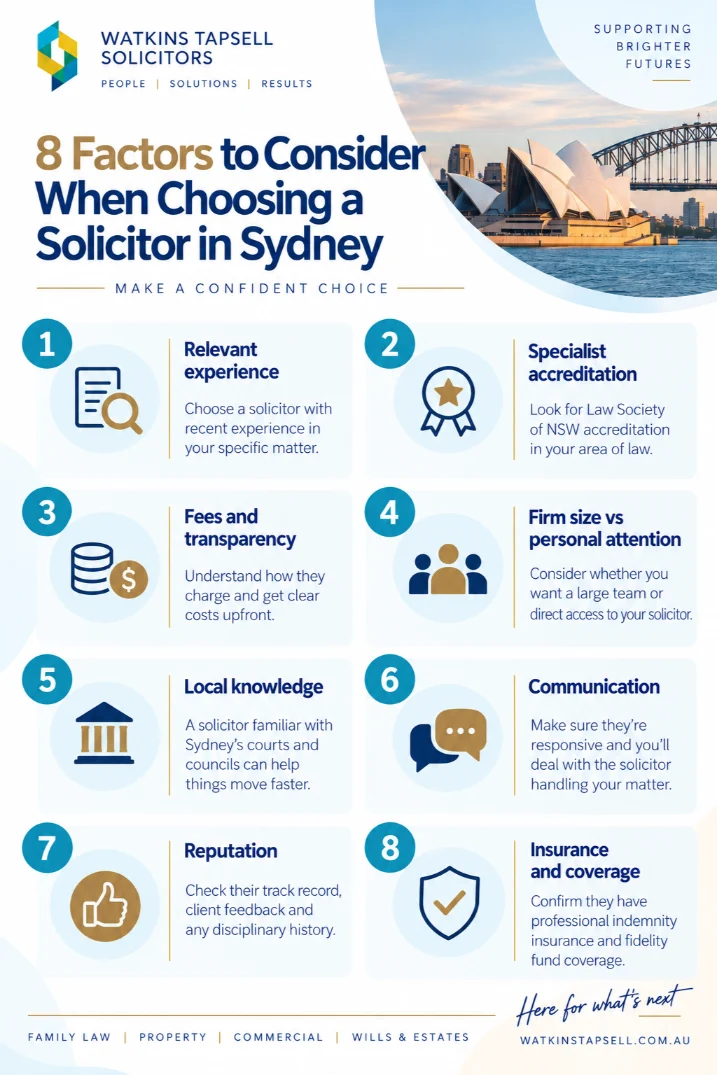
8 Factors to Consider When Choosing a Solicitor in Sydney
1. Relevant experience in your specific matter
A solicitor who’s spent years on commercial litigation isn’t necessarily the right person for a family law property settlement, and vice versa. Ask how many matters like yours the solicitor has handled in the past 12 months, not just how long they’ve practised overall.
2. Specialist accreditation
The Law Society of NSW runs a Specialist Accreditation scheme that recognises solicitors who’ve demonstrated advanced expertise in a particular area of law, such as family law, property, or commercial litigation. It’s not compulsory, but it’s a genuine, independently assessed marker of depth in a field.
3. Fee structure and cost transparency
Fixed fees suit predictable matters like conveyancing or straightforward wills. Hourly rates make more sense for litigation, where the scope can shift. Either way, a solicitor should be (and is legally required to be) upfront about how they charge before any work begins.
4. Firm size versus personal attention
A large CBD firm may offer breadth across many practice areas. A smaller suburban firm often offers more direct access to the solicitor running your file, rather than being passed to a junior associate. Neither is automatically better; it depends on whether your matter needs a big team or a consistent point of contact.
5. Local knowledge and court experience
For conveyancing, estates, and litigation, familiarity with local councils, the NSW Land Registry Services, and the relevant local or district courts speeds things up in practice. A solicitor who regularly appears at your local registry or court already knows the people, the process, and the likely timeframes.
6. Communication and accessibility
Ask directly: will you be dealing with the solicitor named on the engagement letter, or handed to whoever’s available? How quickly do they typically respond to calls and emails? For matters involving stress or urgency, such as family separation or a contract deadline, slow or vague communication compounds an already difficult situation.
7. Reputation and track record
Look beyond star ratings. Ask for examples of matters similar to yours (without breaching confidentiality), check how long the firm has operated in Sydney, and see whether they’re listed with any disciplinary findings on the OLSC Register of Disciplinary Action.
8. Professional indemnity insurance and fidelity fund coverage
Every NSW solicitor holding a practising certificate must be covered by professional indemnity insurance and contribute to the Legal Practitioners’ Fidelity Fund. This protects you if something goes seriously wrong. It’s a baseline requirement, but it’s worth confirming rather than assuming.
How to Verify a Sydney Solicitor’s Credentials
Before engaging anyone, it takes about 2 minutes to confirm they’re legally entitled to act on your behalf.

- Check the Register of Solicitors. The Law Society of NSW maintains a public register of everyone holding a current NSW practising certificate. Search by name or firm to confirm the solicitor is currently licensed, not just previously admitted.
- Understand what a practising certificate confirms. Holding one means the solicitor has completed the required academic and Practical Legal Training requirements, been formally admitted by the Supreme Court of NSW (or another Australian jurisdiction), and committed to ongoing professional development. Practising without a current certificate is unlawful under the Legal Profession Uniform Law.
- Check the disciplinary record. The Office of the NSW Legal Services Commissioner co-regulates the profession alongside the Law Society and keeps a public Register of Disciplinary Action. It’s a useful, if blunt, check before committing to a solicitor for a significant matter.
- Confirm any specialist claims. If a solicitor advertises as an “Accredited Specialist,” that title should be verifiable on the Law Society’s register.
Questions to Ask a Sydney Solicitor Before You Hire Them
- How many matters similar to mine have you handled in the last year, and what was the typical outcome?
- What’s your fee structure for this matter (fixed fee, hourly rate, or a hybrid), and can I get that in writing?
- Who will be working on my file day-to-day?
- What’s your usual turnaround time for calls and emails?
- What are the realistic timeframes and possible complications for a matter like mine?
- Do you have professional indemnity insurance and a current NSW practising certificate?
- What happens if the matter becomes more complex than expected? How will costs be communicated as that happens?
A solicitor who answers these clearly and without hedging is generally one worth trusting. Vague answers, especially around cost, are worth noticing.
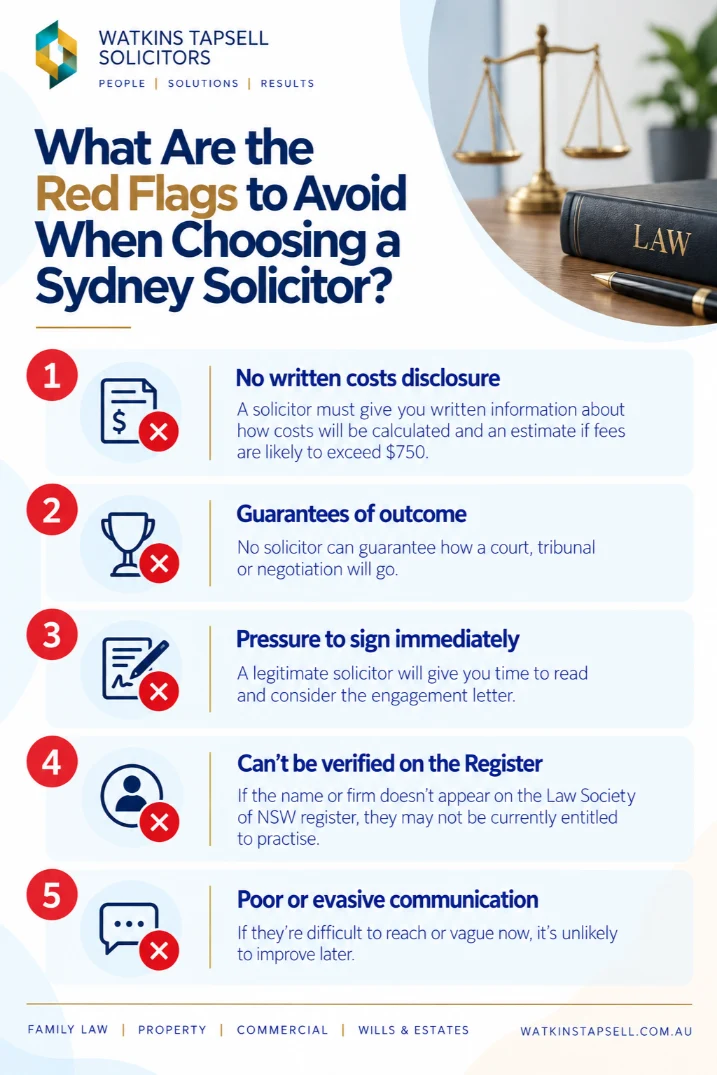
What Are the Red Flags to Avoid When Choosing a Sydney Solicitor?
- No written costs disclosure. Under the Legal Profession Uniform Law, a solicitor must give you written information about how costs will be calculated and an estimate of total legal costs once fees are likely to exceed $750. If a solicitor is reluctant to put anything about fees in writing, that’s a genuine warning sign.
- Guarantees of outcome. No solicitor can honestly guarantee how a court, tribunal, or negotiation will go. Confidence is reasonable; guarantees usually aren’t.
- Pressure to sign immediately. A legitimate solicitor will give you time to read an engagement letter and costs agreement properly, rather than pushing you to sign on the spot.
- Can’t be verified on the Register of Solicitors. If a name or firm doesn’t appear on the Law Society of NSW register, that means you can’t confirm they’re currently entitled to practise.
- Poor or evasive communication from the outset. If a solicitor is difficult to reach or vague before you’ve even signed on, that pattern rarely improves once you’re a client and the matter gets more complicated.
Why Local Experience Makes a Difference
Choosing a solicitor in Sydney is a decision worth taking your time with, even when the underlying legal matter feels urgent. Verify credentials, ask direct questions about fees and communication, and pay attention to how a solicitor handles the small things before you trust them with the big ones. The right fit will usually be obvious within that first conversation.
Watkins Tapsell has been practising as solicitors in Sydney since 1967, covering business law and contracts, commercial litigation, conveyancing, employment law, estates, family law, mediation, and public notary services. That breadth means a matter that starts as a straightforward conveyance and turns into a contract dispute, or a family matter that touches on a business asset, can be handled by one team that already understands the full picture, rather than being passed between unconnected firms.
If you’re currently weighing up solicitors for a personal or business legal matter, the team at Watkins Tapsell offers personalised, experienced guidance across the full range of legal needs. Reach out for a conversation about your matter before you commit to anyone.