

You’ve written your wishes on a piece of paper, signed it, and tucked it in a drawer. But is that enough to make a legally binding will in NSW? The answer is no, and if you haven’t created a valid will, you’re opening your loved ones up to a potential estate dispute after you’re gone.
Under the Succession Act 2006 (NSW), a will only takes legal effect if it meets a specific set of formal requirements, and getting even one of them wrong can mean your estate is dealt with as though you never made a will at all.
This guide walks through what NSW law requires, what a will typically costs, the mistakes that most often catch people out, and what happens if you never get around to it.
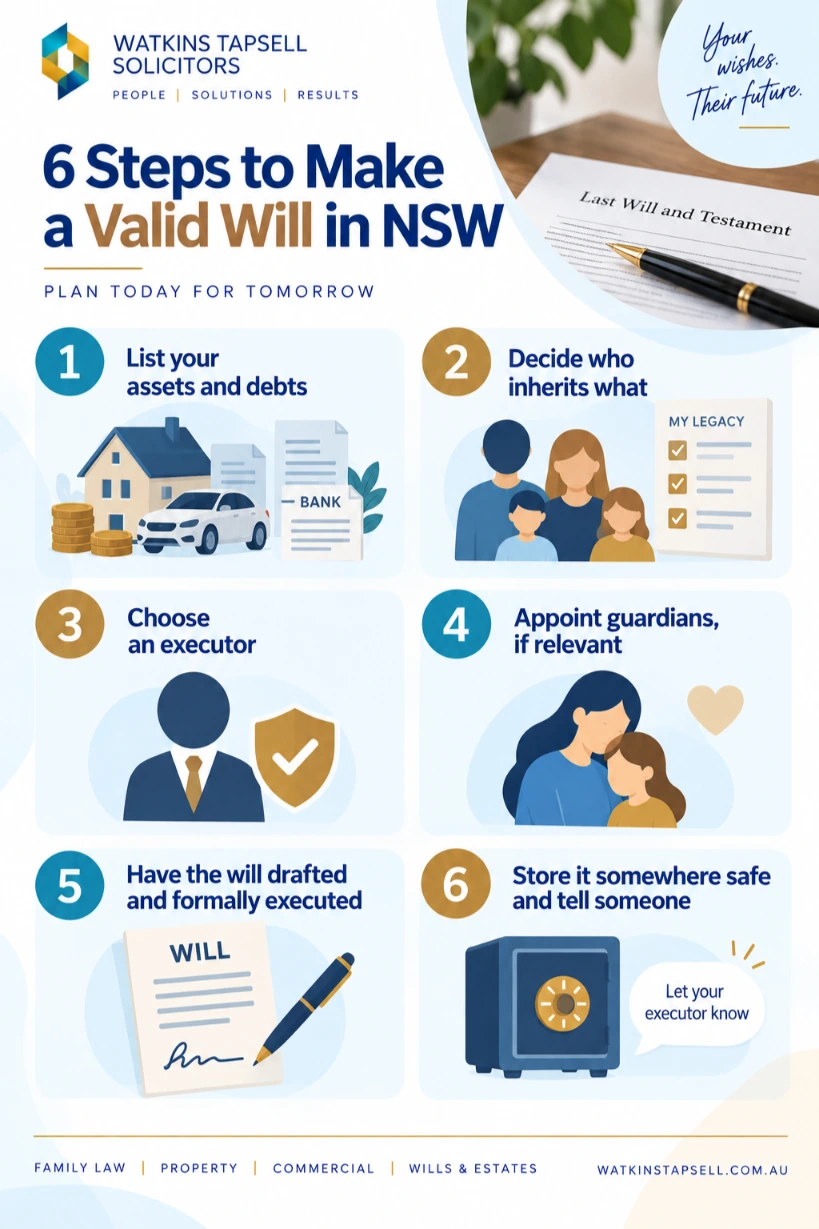
6 Steps to Make a Valid Will in NSW
Making a will isn’t complicated once you know the sequence. Here’s the process most people follow, whether they’re working with a solicitor or preparing the groundwork before an appointment.
1. List your assets and debts
Before you can decide who gets what, you need a clear picture of what you own, including property, superannuation, bank accounts, shares, vehicles, business interests, and what you owe. Superannuation and jointly owned property often sit outside your will entirely, so it’s worth understanding which assets your will can control.
2. Decide who inherits what
This is where most of the emotional weight sits. Think through your beneficiaries, whether you want to leave specific gifts (a piece of jewellery, a car) as well as a share of the residual estate, and how you’d like blended family or step-children situations handled.
3. Choose an executor
Your executor administers your estate after you die, so it should be someone you trust to handle paperwork, deal with the Supreme Court if probate is needed, and manage your beneficiaries fairly. You can appoint more than one person, and it’s sensible to name a backup executor in case your first choice can’t act.
4. Appoint guardians, if relevant
If you have children under 18, your will is where you nominate who should care for them if both parents die. Without this, the decision falls to the Family Court.
5. Have the will drafted and formally executed
This is a step for a solicitor. A properly drafted will accounts for the 30-day survivorship rule, includes a residuary clause so nothing is left in limbo, and is written in language that can’t be misread by the court.
6. Store it somewhere safe and tell someone where it is
A perfectly valid will is useless if nobody can find it after you die. Options include storing it with your solicitor, lodging it with the NSW Trustee and Guardian for a fee, or keeping it at your bank. Whichever you choose, make sure your executor knows where to look.
Legal Requirements for a Valid Will in NSW
The formal requirements for a valid will are set out in section 6 of the Succession Act 2006 (NSW), and the State Library of NSW’s legal guide to wills and estates clearly sets them out for people navigating the process themselves. Unless every one of the following is met, the court may treat your estate as intestate, meaning it’s distributed as if you’d never made a will:
- It must be in writing, typed or handwritten, though typed is strongly preferable for clarity.
- It must be signed by the will-maker (or by someone else, at your direction and in your presence, if you’re physically unable to sign).
- Your signature must be made or acknowledged in front of two witnesses, both present at the same time.
- At least two witnesses must sign in your presence, though not necessarily in each other’s presence.
- The signature must be made with the clear intention of executing the will, not as a draft or a discussion document.
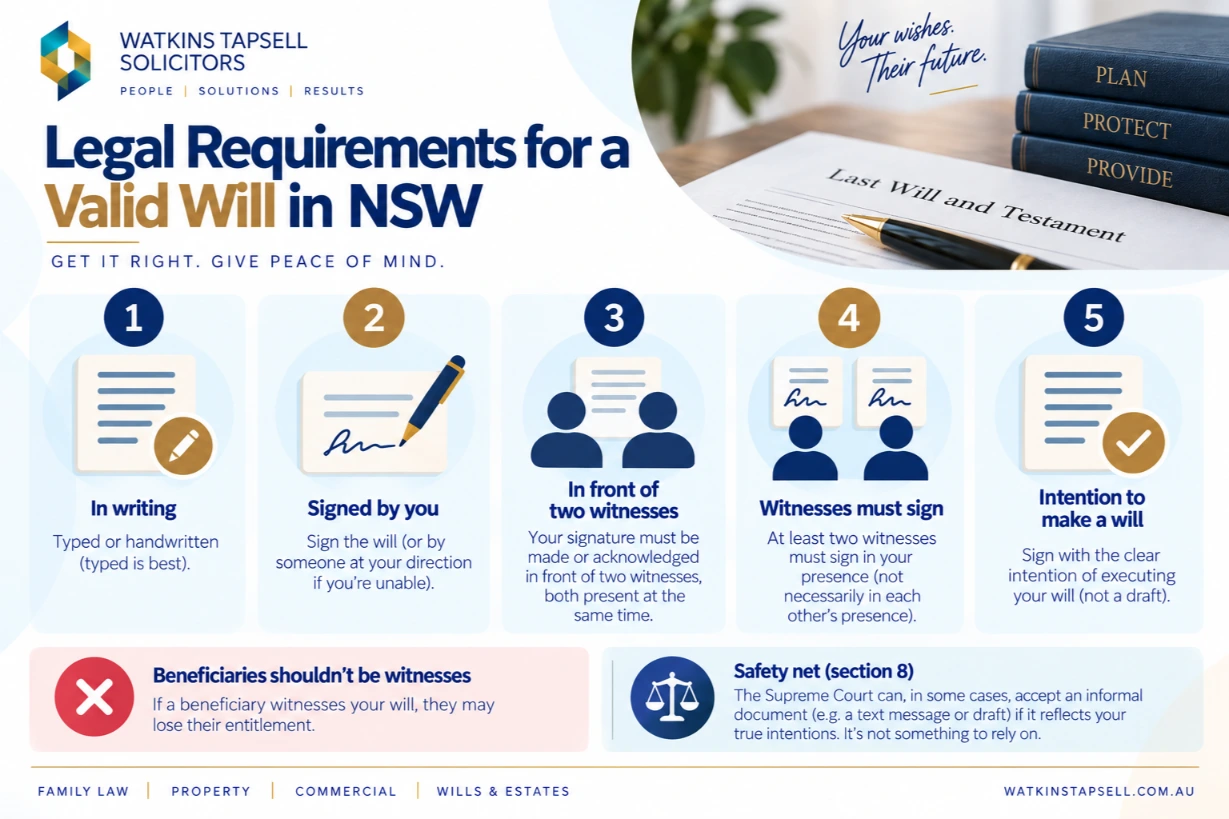
Beneficiaries generally shouldn’t act as witnesses, because doing so can void their entitlement under the will. And while an attestation clause (the paragraph describing how the will was signed and witnessed) isn’t strictly compulsory, most properly drafted wills include one, because it heads off arguments later about whether the formalities were properly followed.
There’s also a safety net: Section 8 of the Succession Act allows the Supreme Court to dispense with the formal requirements in some cases. For example, admitting an informal document as a will if the court is satisfied it truly reflects the deceased’s intentions. This has, in rare cases, extended to text messages and even unsent drafts. It’s not something to rely on, though. Relying on section 8 means your family is arguing your case in court after you’ve died, rather than your wishes being followed as a matter of course.

How Much Does It Cost to Make a Will in NSW?
Costs vary considerably depending on how you go about it and how complex your estate is.
- DIY will kits, sold through newsagents or online, typically cost between $30 and $100. They’re the cheapest option but carry the highest risk of error. Witnessing mistakes and unclear wording are common causes of later disputes, and a DIY kit won’t flag issues specific to your situation, such as a blended family or a jointly owned business.
- The NSW Trustee and Guardian charges from around $440 for a straightforward will, with the service provided free of charge to anyone on a full Centrelink age pension.

The cheapest option upfront isn’t always the cheapest option overall. A poorly worded or incorrectly witnessed will can end up costing your estate tens of thousands of dollars in legal fees if it’s contested. Spending a bit more to have a solicitor draft a will tailored to your actual circumstances is usually the more economical decision once you look past the initial invoice.
Common Mistakes to Avoid When Making a Will in NSW
Most invalid or problem-riddled wills fail for a small handful of recurring reasons.
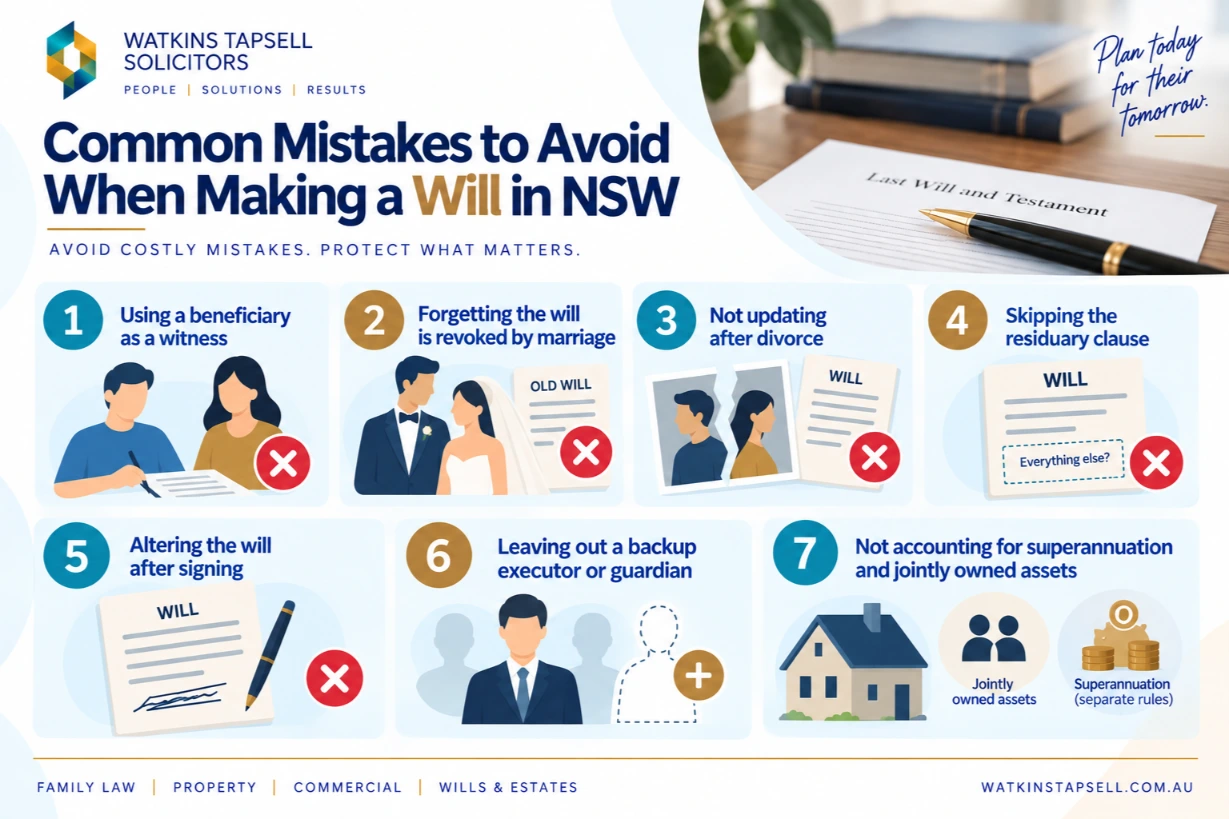
- Using a beneficiary as a witness. As above, this can strip that person of their inheritance, even if the rest of the will is perfectly valid.
- Forgetting the will is revoked by marriage. Under section 12 of the Succession Act, marrying automatically revokes an earlier will, unless it was made specifically in contemplation of that marriage. People who marry later in life are often unaware that their old will no longer applies.
- Not updating the will after divorce. Divorce doesn’t cancel the whole will, but it does revoke any gift to a former spouse and their appointment as executor, trustee or guardian, unless you’ve stated a contrary intention. Relying on this partial revocation instead of drafting a fresh will tends to leave gaps.
- Skipping the residuary clause. If your will doesn’t include a clause dealing with “everything else” (assets you haven’t specifically named, or gifts that fail because a beneficiary died before you), that portion of your estate can fall back into intestacy rules, even though the rest of your will is valid.
- Altering the will after signing. You can’t cross out a clause or scribble in a change once a will is executed. Any alteration must be signed and witnessed, just like the original document, or the court will assume it was made after signing and disregard it.
- Leaving out a backup executor or guardian. If your named executor has died, or your named guardian is no longer able to take on the role, and you haven’t nominated an alternative, the decision is left to the court.
- Not accounting for superannuation and jointly owned assets. Many people assume their will controls everything they own. It doesn’t – super is generally paid according to a separate binding nomination, and jointly held property (held as joint tenants) usually passes automatically to the surviving owner, regardless of what the will says.
Watkins Tapsell’s wills and estates lawyers address each of these issues with clients before a will is drafted, not after a mistake surfaces in probate. If you’re in Sydney or the Sutherland Shire and want a will that holds up, our team can talk you through your options and draft a document that reflects your specific circumstances.
How to Update, Change or Revoke a Will in NSW
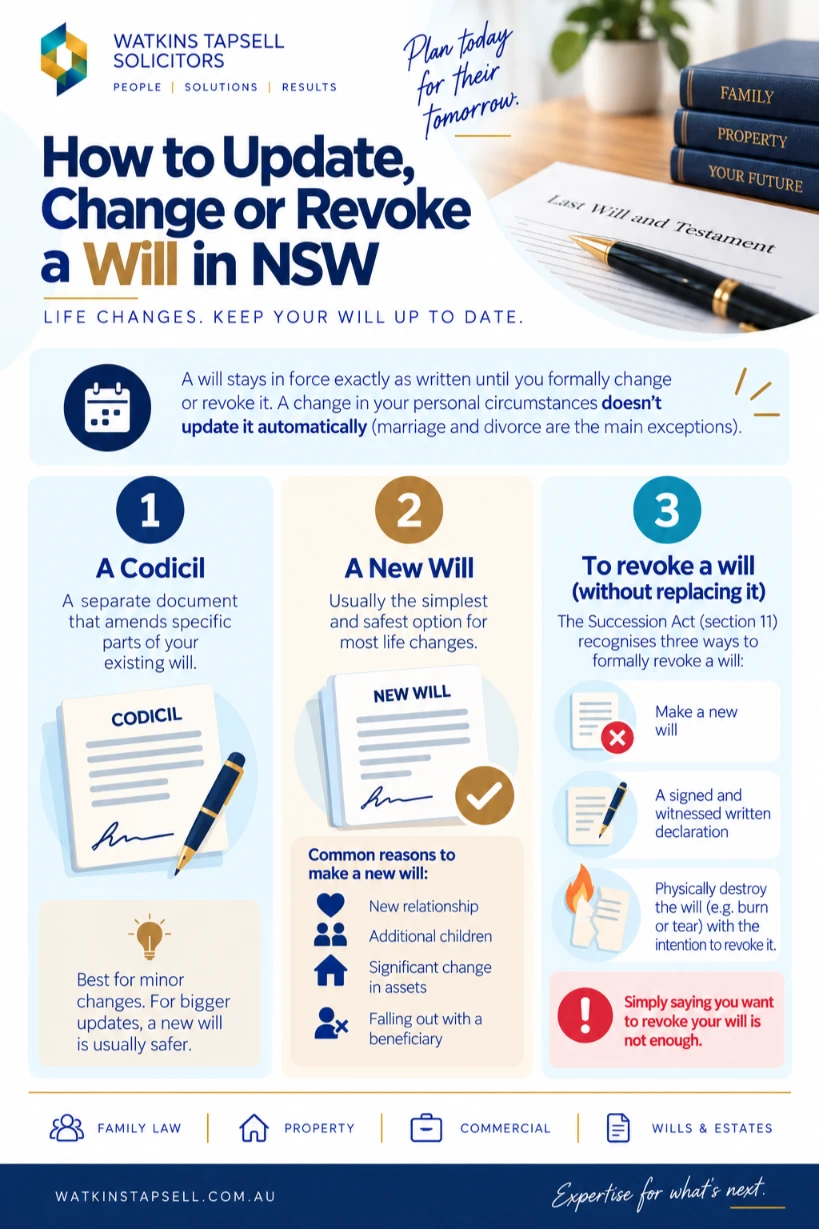
A will stays in force exactly as written until you formally change or revoke it. A change in your personal circumstances doesn’t update it automatically (marriage and divorce being the main exceptions noted above).
There are two main ways to make changes:
A Codicil
This is a separate document that amends specific parts of an existing will, executed with the same formalities as a will itself. Codicils were once common, but for anything beyond a very minor change, most solicitors now recommend drafting a new will altogether – it’s cleaner and avoids the risk of a codicil accidentally revoking the will it was meant to update.
A New Will
For most life changes (a new relationship, additional children, a significant change in assets, a falling out with a previously named beneficiary), preparing a new will is usually simpler and safer than trying to patch the old one.
To formally revoke a will without replacing it, the Succession Act (section 11) recognises a few specific methods: making a new will, a signed and witnessed written declaration of your intention to revoke it, or physically destroying the will (burning, tearing, or otherwise) with the intention of revoking it. Simply saying you want to revoke your will isn’t enough.
What Happens If You Die Without a Will in NSW?
If you die without a valid will, you die “intestate,” and your estate is distributed according to a fixed formula set out in the Succession Act 2006, not according to your actual wishes.
The intestacy rules, administered by NSW Trustee and Guardian, work through a fixed order of priority:
- If you leave a spouse and children from that same relationship, your spouse generally inherits the whole estate.
- If you leave a spouse and children from a previous relationship, your spouse receives your personal effects, a statutory legacy (adjusted periodically, $587,649 as at May 2025) and half of whatever remains, with your children sharing the other half equally.
- If there’s no surviving spouse, your children inherit in equal shares.
- If there’s no spouse and no children, the estate passes to your parents, then to siblings, then grandparents, then aunts, uncles and first cousins, in that order.
- If no eligible relative can be found at all, the estate passes to the NSW Government.
Beyond the distribution itself, dying intestate creates practical headaches for the people you leave behind. Instead of an executor you chose acting immediately, someone has to apply to the Supreme Court for Letters of Administration, and the administrator often has to establish a certified family tree before any assets can be distributed. This process can take considerably longer than administering a straightforward will, particularly if relatives need to be traced interstate or overseas.
Get Your Will Sorted Properly
A will is one of those documents that’s urgent in a way that never feels urgent, right up until it is. The good news is that for most people, getting it right isn’t complicated; it just needs to be done properly, by someone who understands where the common pitfalls sit.
Watkins Tapsell has been advising individuals and families across Sydney and the Sutherland Shire on wills and estate planning for more than two decades. As experienced solicitors in Sydney, we take the time to understand your specific circumstances rather than working from a template.
Whether you’re making your first will, updating one after a major life change, or setting up a testamentary trust for a blended family, call us on (02) 9521 6000 or get in touch online to arrange a time to talk it through.