

You’ve been separated for over a year, and your former partner still hasn’t signed the divorce papers. Or maybe you’re both ready to file together and just want the process handled properly. Whether your divorce ends up contested or uncontested changes almost everything that follows, including what you’ll pay, how long it takes, and whether you’ll ever need to speak in a courtroom.
Divorce in Australia is a “no-fault” process. The court doesn’t ask who caused the breakdown of the marriage, only whether you’ve been separated for 12 months and whether the marriage has irretrievably broken down. But how you get there still matters. An uncontested, joint application can be finalised without either of you attending court. A contested one can stretch on for months while a judge decides what happens.
This guide breaks down the practical differences, walks through both application pathways, and flags the situations that most often tip an uncontested divorce into a contested one.
Contested vs Uncontested Divorce at a Glance
| Uncontested Divorce | Contested Divorce | |
| Agreement | Both parties agree to divorce | One party disputes the application or key facts |
| Application type | Usually a joint application | Usually a sole application |
| Service of documents | Not required | Applicant must formally serve the respondent |
| Court attendance | Generally not required | Often required if the application is opposed |
| Typical timeframe | Around 4–6 weeks to a hearing date once filed | Can extend to several months, depending on the dispute |
| What it resolves | The legal end of the marriage only | The legal end of the marriage only – property and parenting are separate |
Neither a contested nor an uncontested divorce legal services application deals with property division or parenting arrangements. Those are handled as separate legal processes, which is often where the real disagreement lies.
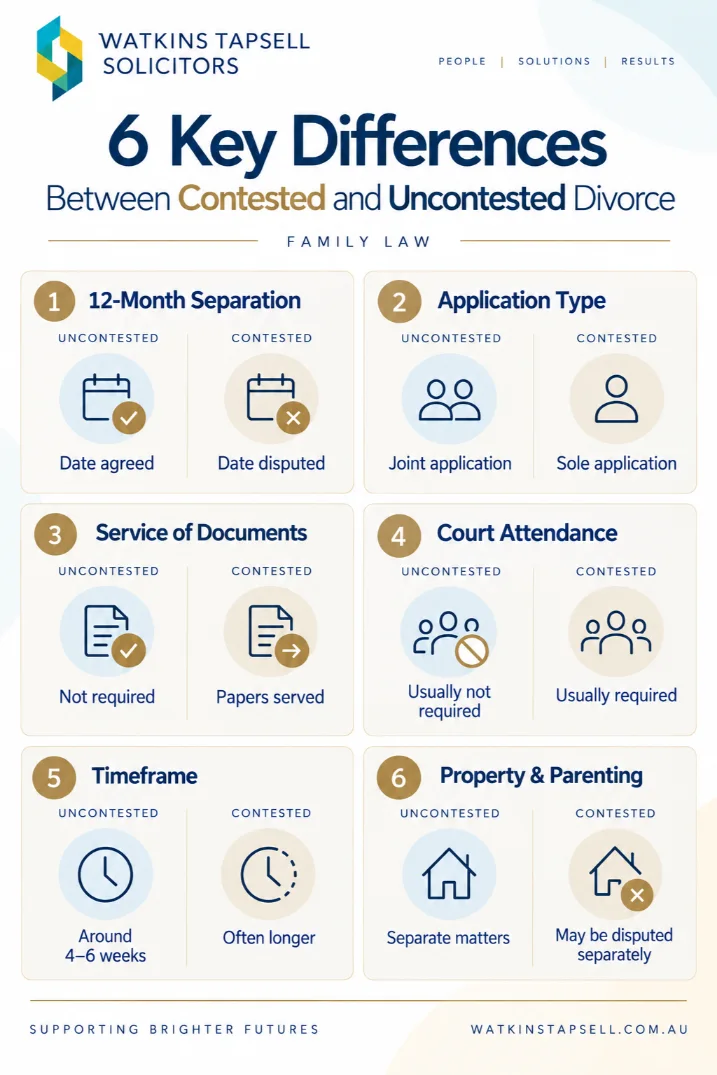
6 Key Differences Between Contested and Uncontested Divorce
1. Agreement on the 12-Month Separation Requirement
Every divorce application in Australia rests on the same legal ground: you and your spouse must have been separated for a continuous period of at least 12 months and one day before you can file. In an uncontested divorce, both parties agree to the separation date without dispute. In a contested divorce, the separation date itself is sometimes the point of dispute. One spouse might argue the couple hadn’t truly separated, or that the 12-month period hasn’t yet been met.
2. Sole vs Joint Divorce Application
An uncontested divorce is typically filed as a joint application, with both spouses signing on as applicants. A contested (or simply one-sided) divorce is filed as a sole application, where one spouse applies and the other is named as the respondent. Both application types use the same online form through the Commonwealth Courts Portal; the only differences are who signs and what happens next.
3. Service of Documents Requirements
In a joint application, formal service isn’t required because both parties have already signed the application together. In a sole application, the applicant is legally required to serve a copy of the divorce papers on the respondent by one of the following methods: through a process server; by a friend or family member over 18; or by post. If the other party can’t be located, additional court orders for substituted service may be needed.
4. Court Attendance and Hearing Obligations
For a straightforward, uncontested joint application, neither party is generally required to attend the divorce hearing. Under changes to the Federal Circuit and Family Court Rules that took effect in June 2025, sole applicants are no longer automatically required to attend a hearing simply because children under 18 are involved. Attendance is now generally only needed if a party requests it, if the respondent files a Response to Divorce opposing the application, or if the court has specific concerns. If the divorce is contested, though, both parties will typically need to attend so the presiding judicial officer can hear from them directly.
5. Timeframe from Application to Divorce Order
Once filed, an uncontested joint application is usually allocated a hearing date within roughly four to six weeks, and because attendance isn’t required, the divorce order is generally made on the papers. A contested application takes longer by nature. After service, the respondent has 28 days (or 42 days if served overseas) to file a Response to Divorce, and if they do, the matter proceeds to a defended hearing, which can push the overall timeframe out by several months.
6. Impact on Property Settlement and Parenting Arrangements
A contested divorce application, on its own, doesn’t affect property settlement or parenting matters. Those run on entirely separate tracks under the Family Law Act 1975 (Cth). But couples who are contesting the divorce itself are often also in dispute over property and children, and it makes sense to have the same experienced divorce property lawyer and family law team across all three issues, so nothing falls through the gaps.
How to Apply for an Uncontested Divorce in Sydney
Eligibility Under the Family Law Act 1975
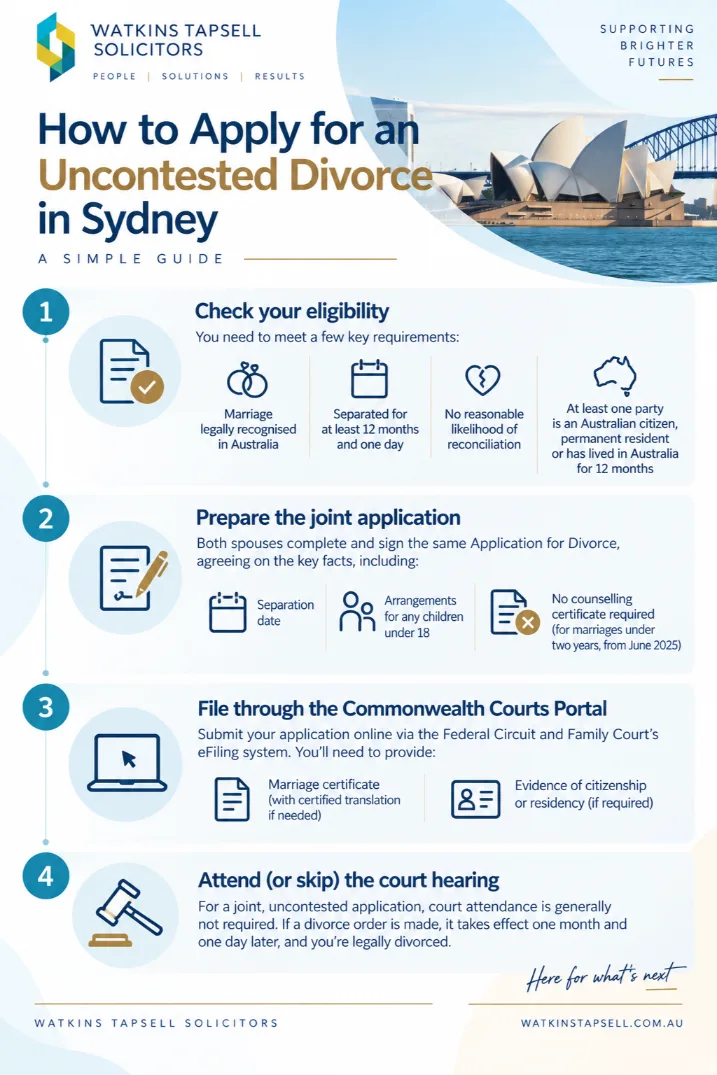
To apply for a divorce in Sydney, you need to satisfy the court on a few points:
- Your marriage is legally recognised in Australia
- You and your spouse have been separated for at least 12 months and one day
- There’s no reasonable likelihood of reconciliation
- Either party is an Australian citizen, treats Australia as their permanent home, or has lived here for the past 12 months.
If you’ve spent part of that 12-month period living under the same roof, you’ll need to file additional evidence to satisfy the court that you were truly separated during that time.
Preparing the Joint Application for Divorce
Both spouses complete and sign the same Application for Divorce, agreeing on the facts, including the separation date and, where relevant, the arrangements in place for any children under 18. As of June 2025, couples married for less than two years are no longer required to obtain a counselling certificate before filing, following amendments to the Family Law Act.
Filing Through the Commonwealth Courts Portal
Divorce applications are filed electronically through the Commonwealth Courts Portal, the Federal Circuit and Family Court of Australia’s online eFiling system. You’ll need supporting documents such as your marriage certificate (with a certified translation if it isn’t in English) and evidence of citizenship or residency if either party wasn’t born in Australia.
Attending (or Skipping) the Federal Circuit and Family Court Hearing
For a joint, uncontested application, court attendance generally isn’t required. If a divorce order is made, it takes effect one month and one day later, at which point you’re legally divorced and free to remarry if you choose.
How to Respond to a Contested Divorce Application in Sydney
When a Divorce Becomes Contested
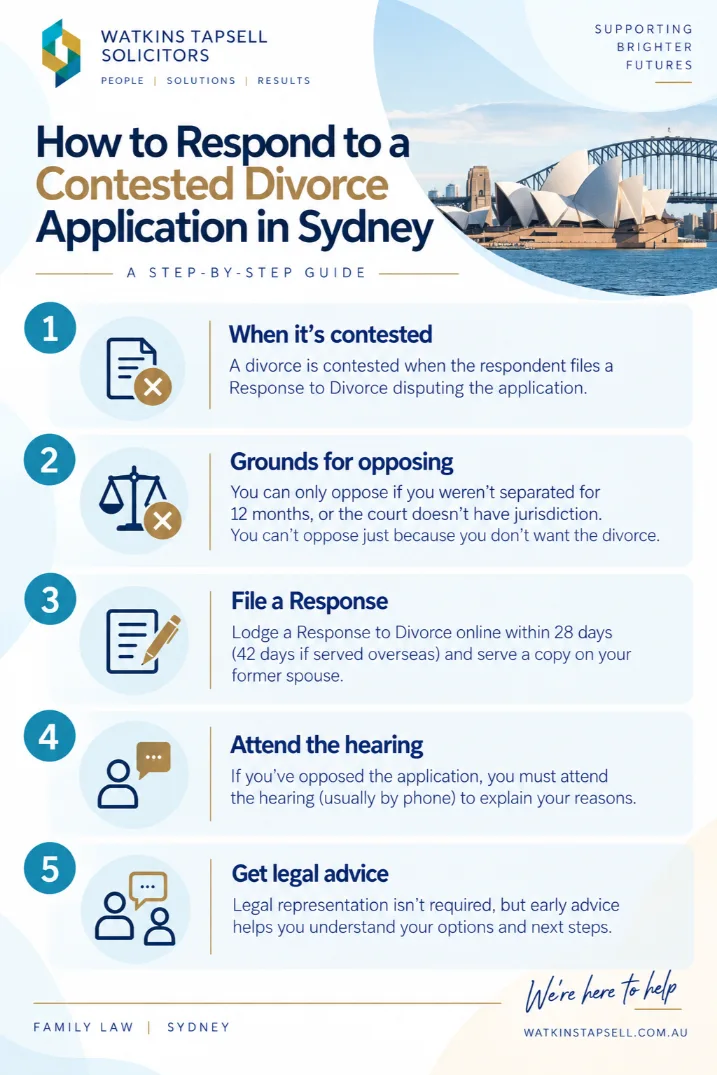
A divorce application becomes contested when the respondent files a formal Response to Divorce disputing the application, rather than simply acknowledging service. This is different from disputing property or parenting arrangements, which don’t make the divorce itself contested.
Grounds for Opposing a Divorce Application
The grounds available to oppose a divorce are narrow. You can only contest the application on the basis that the couple hasn’t been separated for the required 12 months, or that the court doesn’t have the jurisdiction to grant the divorce at all (for example, if the marriage wasn’t legally valid, or neither party meets the citizenship or residency requirements). You can’t oppose a divorce simply because you don’t want the marriage to end, or because you disagree with how property or parenting matters are being handled.
Filing a Response to Divorce (Form)
If you’ve been served with a divorce application and want to oppose it, you need to file a Response to Divorce through the Commonwealth Courts Portal. If served within Australia, this must be done within 28 days of service; if served overseas, you have 42 days. The response needs to clearly set out your reasons for opposing the application, and you’ll also need to serve a copy on your former spouse.
Attending the Divorce Hearing in Sydney
If you’ve filed a Response to Divorce opposing the application, you must attend the hearing (usually conducted electronically by phone) to explain your reasons. If you don’t attend, the court can treat the matter as undefended and grant the divorce regardless. This cuts both ways: if you’re the applicant and your spouse has opposed the divorce, you should also plan to attend.
When Legal Representation Is Required
Legal representation isn’t compulsory for a divorce hearing, but given how narrow the grounds for opposition are, getting advice from a family law firm early on is worth it. It helps you understand realistically whether you have valid grounds to contest, or whether your energy and legal costs are better spent resolving the property and parenting issues that are usually the real source of conflict.
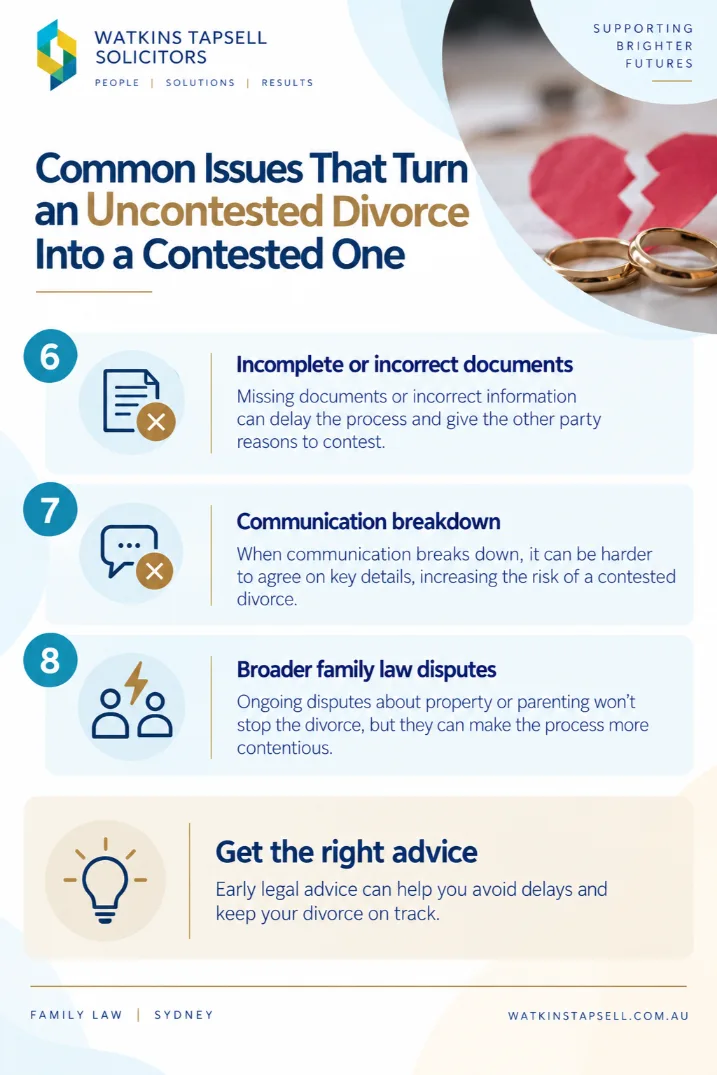
Common Issues That Turn an Uncontested Divorce Into a Contested One
Disputes Over the Separation Date
This is one of the most common flashpoints. If one party says separation occurred 14 months ago and the other insists it was only 9 months, the 12-month threshold itself becomes the issue, and the court will need evidence to establish the true date of separation.
Difficulty Locating or Serving the Other Party
A sole application can stall and sometimes be contested by default if the respondent can’t be located for service. In these cases, the applicant may need to apply for an order for substituted service (serving documents by another method, such as email or social media) or dispensation of service altogether.
Marriage Duration Under Two Years and Counselling Certificate Requirements
Before June 2025, marriages under two years required a counselling certificate or a court exemption before a divorce application could proceed. This requirement no longer applies, but it’s still worth confirming your application reflects the current rules, since outdated information circulates widely.
Overseas Marriages and Jurisdiction Concerns
If your marriage took place overseas, or if either party’s citizenship or residency status is unclear, jurisdiction can become a real sticking point. The court needs to be satisfied it has the power to grant the divorce, and gathering the right documentation early on avoids unnecessary delays.
Care Arrangements for Children Under 18
While parenting arrangements don’t need to be finalised before a divorce is granted, the court must be satisfied that proper arrangements are in place for the care, welfare, and development of any children under 18. When those arrangements are unresolved or disputed, the process can be complicated, and it’s often the point at which child custody legal advice becomes just as important as the divorce application itself. Working out day-to-day care is one piece of it; getting the right child support law firm involved for ongoing arrangements is usually the other.
Getting the Right Support for Your Sydney Divorce
Most divorces in Sydney are more straightforward than people expect. A joint, uncontested application, correctly prepared, can be finalised in a matter of weeks without either party setting foot in court. But separation rarely stops at the divorce paperwork. Property has to be divided, and if there are children involved, care arrangements usually need to be sorted out too.
That’s where having the right team matters. As Sydney solicitors with decades of experience across family law, Watkins Tapsell helps clients across Sydney and the Sutherland Shire work through divorce applications, contested and uncontested alike, with the same compassionate, straightforward approach, whether your matter is amicable or in dispute. Our separation lawyers can help you understand which pathway applies to your situation, prepare your application correctly the first time, and represent you if the matter does become contested.
If you’re not sure where your situation sits, or you’d simply like to understand your options before deciding what to do next, get in touch with our family law team for a conversation about what’s ahead.